
Calculusity
Complex Numbers Intro
If $x$ is a positive number then $x^2$ is positive because positive times positive gives positive
If $x$ is a negative number then $x^2$ is positive because negative times negative gives positive
If $x=0$ then $x^2=0$
From this if follows that $x^2\geq 0$ for all real $x$. Thus the parabolic curve $y=x^2$ sits on the $x$ axis and never enters negative territory below the $x$ axis as shown in Fig. 1.
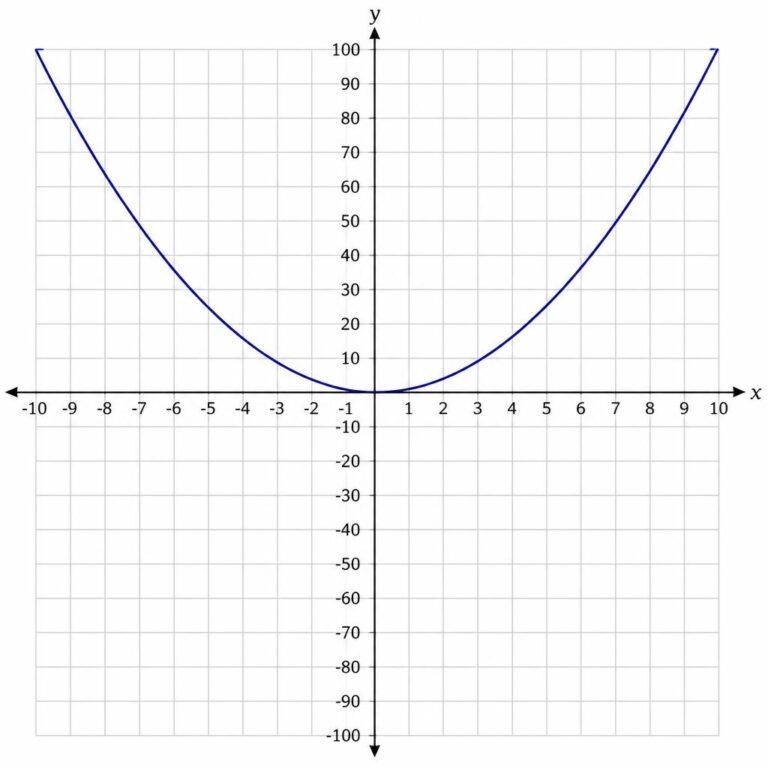
Fig. 1 Parabolic curve of $y=x^2$
However because $x^2$ is never negative the equation $x^2=\mathbin{-}1$ (or any other negative number) has no real solutions. At this point most people would simply shrug their shoulders and say “well that’s that”. But hang on and suppose we invent an “imaginary” number $i$ that satisfies the following two equivalent equations:
$$\sqrt{\mathbin{-}1}=i$$
$$i^2=\mathbin{-}1$$
Now if we are asked to find the square root of any negative number we can come up with a solution. For example
$$\sqrt{\mathbin{-}8}=\sqrt{4\times2\times\mathbin{-}1}=\sqrt{4}\sqrt{2}\sqrt{\mathbin{-}1}=2\sqrt{2}i$$
$i$ obeys the usual rules of algebra with the added requirement that $i^2=\mathbin{-}1$. Thus we have:
$$i^0=1$$
$$i^1=i$$
$$i^2=\mathbin{-}1$$
$$i^3=i^2i=\mathbin{-}1\times i=\mathbin{-}i$$
$$i^4=i^2i^2=\mathbin{-}1\times\mathbin{-}1=1$$ and the pattern repeats
Numbers like 0, 1, $\frac{7}{13}$, $2\sqrt{2}$, $\pi$ are called real numbers
Numbers like $5i$ and $\sqrt{3}i$ are called imaginary numbers
We can also have combinations of real and imaginary numbers such as $5+3i$. The set of all numbers real, imaginary and a combination of both is the set of complex numbers which is denoted by $\mathbb{C}$. If $a$ and $b$ are real numbers we can combine the real number $a$ with the imaginary number $bi$ to write the general as complex number as:
$$z=a+bi$$
The real part of $z$ is Re$(z)=a$
The imaginary part of $z$ is Im$(z)=b$
Note the imaginary part of the complex number $z$ is the real number $b$.
If the real part of $z$ is zero then $z=0+bi=bi$ so $z$ is an imaginary number.
If the imaginary part of $z$ is zero then $z=a+0i=a$ so $z$ is a real number.
The complex number $z=a+bi$ is said to be written in rectangular of cartesian form.
It can be written in another form known as an ordered pair $(a, b)$.
Note $(a, b) = a+bi$ and $(b, a)= b+ai$ are different because order matters for ordered pairs.
$z=a+bi=(a, b)$ can be plotted as a point in what is called the complex plane or Argand Plane or Gauss Plane.
$a$ is plotted on the real or $x$ axis
$b$ is plotted on the imaginary or $y$ axis.
In Fig. 2 we show plots of the following four complex numbers:
$z_1=3+4i$, $z_2=\mathbin{-}2+3i$, $z_3=\mathbin{-}3\mathbin{-}3i$, $z_4=2\mathbin{-}4i$
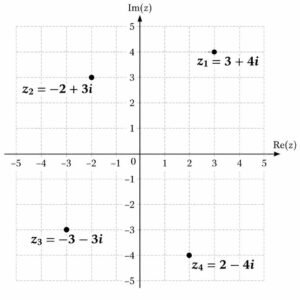
Fig. 2 How to plot complex numbers in the complex plane
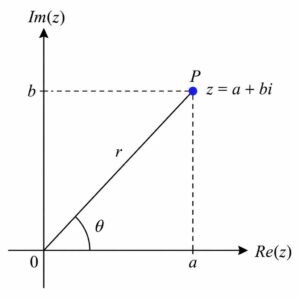
Fig. 3 Modulus and argument of a complex number
If two complex numbers $a+bi$ and $c+di$ are equal then they are at the same point in the complex plane and $a=c$, $b=d$. The converse is also true, if $a=c$ and $b=d$ then $a+bi$ and $c+di$ are located at the same point in the complex plane and $a+bi=c+di$. Thus we may write:
$$a+bi=c+di\iff a=c, b=d$$
This can be used to split a single complex equation into two real equations that are then solved simultaneously. We illustrate the method by finding the square root of $i$.
Let
$$\sqrt{i}=a+bi$$
we square this equation to get
$$i=0+1i=(a+bi)^2=a^2+2abi+b^2i^2=(a^2\mathbin{-}b^2)+(2ab)i$$
equating the imaginary parts gives
$$2ab=1$$
equating the real parts gives
$$a^2\mathbin{-}b^2=0$$
or
$$a=\pm b$$
Using $a=b$ and $2ab=1$ gives $2b^2=1$ or $b=\pm\frac{1}{\sqrt{2}}=a$
Using $a=\mathbin{-}b$ and $2ab=1$ gives $b^2=\mathbin{-}\frac{1}{2}$ which is a dead end since $b$ is real.
Final solution is $a=b=\pm\frac{1}{\sqrt{2}}$
thus
$$\sqrt{i}=\pm\frac{1}{\sqrt{2}}\pm\frac{1}{\sqrt{2}}i$$
Fig. 3 shows the complex number $z=a+bi$ located at point $P$ and introduces two new variables $r$ and $\theta$
$0\leq r$ is the distance of $P$ from the origin $O$
$r$ is called the modulus or absolute value of the complex number z
$$r=\mod(z)=|z|$$
$0\leq\theta < 2\pi$ is the angle that $OP$ makes with the positive $x$ axis measuring in the anticlockwise direction. Alternatively it is the negative of the angle that $OP$ make with the $x$ axis measuring in the clockwise direction.
$\theta$ is called the angle, argument, amplitude or phase of $z$
$$\theta=\arg(z)$$
Note: The argument is unchanged if we add any integer multiple of $2\pi$ to the principal value $\theta$ ie. $\arg(z)=\theta+2\pi n$ where $n=0,\pm1,\pm2,\pm3,\cdots$
We can use the variables $r$ and $\theta$ to write a complex number $z$ in modulus-argument form thus
$$z=(r, \theta)$$
$a$, $b$, $r$, $\theta$ are related by the following transformation equations
$$r=|z| = |a+bi|=\sqrt{a^2+b^2}$$
$$\theta=\arg(z)=\arctan \left(\frac{b}{a}\right)$$
$$a=r\cos\theta$$
$$b=r\sin\theta$$
Let us now try to write $i$ in modulus argument form
$$i=0+1i$$
so we have $a=0$ and $b=1$
$$r=\sqrt{a^2+b^2}=\sqrt{0^2+1^2}=1$$
and
$$\theta=\arctan\left(\frac{b}{a}\right)=\arctan\left(\frac{1}{0}\right)=\arctan\infty$$
Thus we get $\theta=\frac{\pi}{2}$ measuring anticlockwise from the positive $x$ axis or $\theta=\mathbin{-}\frac{3\pi}{2}$ measuring clockwise from the positive $x$ axis. Now we can write $i$ in modulus-argument form as $(1,\frac{\pi}{2})$ or $(1,\mathbin{-}\frac{3\pi}{2})$.
The equations $a=r\cos\theta$ and $b=r\cos\theta$ give yet another way of writing complex numbers called the polar or trigonometric form
$$z=a+bi=r\cos\theta +ir\sin\theta = r(\cos\theta+i\sin\theta)$$
Finally we may use series for $\sin\theta$ and $\cos\theta$ to write
$$\cos\theta +i\sin\theta = \left(1\mathbin{-}\frac{\theta^2}{2!}+\frac{\theta^4}{4!}+\cdots\right) +i\left(\theta\mathbin{-}\frac{\theta^3}{3!}+\frac{\theta^5}{5!}\mathbin{-}\cdots\right)= 1+i\theta+\frac{{(i\theta)}^2}{2!}+\frac{{(i\theta)}^3}{3!}+\frac{{(i\theta)}^4}{4!}+\frac{{(i\theta)}^5}{5!}\cdots$$
Thus we arrive at Euler’s identity
$$\cos\theta +i\sin\theta = e^{i\theta}$$
So a complex number can be written as
$$z=re^{i\theta}$$
This is called the Exponential or Euler form of a complex number and may also be written as
$$z=|z|e^{i\arg(z)}$$
To write a number in exponential from all we need to know are its modulus $r$ and its phase $\theta$.
If the modulus $r=0$ then whatever the phase is we get $z=0$ and the point is at the origin of the complex plane.
If $r=1$ then $z=e^{i\theta}$ lies on the unit circle centered on the origin. There are infinitely such points but the following four stand out.
when $\theta=0$ we have $z=e^{i0}=\cos0+i\sin0=1+0i=1$
when $\theta=\frac{\pi}{2}$ we have $z=e^{i\frac{\pi}{2}}=\cos\frac{\pi}{2}+i\sin\frac{\pi}{2}=0+1i=i$
when $\theta=\pi$ we have $z=e^{i\pi}=\cos\pi+i\sin\pi=\mathbin{-}1+0i=\mathbin{-}1$
when $\theta=\frac{3}{2}\pi$ we have $z=e^{i\frac{3}{2}\pi}=\cos\frac{3}{2}\pi+i\sin\frac{3}{2}\pi=0\mathbin{-}1i=\mathbin{-}i$
These points are shown in Fig. 4.
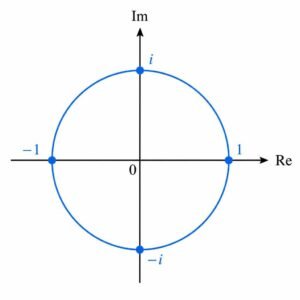
Fig. 4. Some important complex numbers that lie on the unit circle
Now $e^{i\theta}$ corresponds to an anticlockwise rotation about the origin through an angle of $\theta$ So if you start at the point $(r, 0)$ and rotate anticlockwise by $\theta$ you end up at the point $re^{i\theta}$. Now if we start at $(1, 0)$ and rotate anticlockwise about the origin by $\pi$ we end at $(\mathbin{-1}, 0)$. Thus
$$e^{i\pi}=\mathbin{-1}$$
which gives Euler’s Identity
$$e^{1\pi}+1=0$$
$e=2.71828. . .$ is the base of natural logarithms
$\pi=3.14159. . .$ is the circle constant
$i$ is the imaginary unit given by $i^2=\mathbin{-1}$
1 is the multiplicative identity
0 is the additive identity
Thus Euler’s Identity connects five of the most important constants in mathematics in one tidy equation.
We now sum up the five forms of a complex number that we encountered.
Rectangular or Cartesian $a+bi$
Ordered Pair $(a, b)$
Modulus-argument $(r, \theta)$
Polar or Trigonometric $r(\cos\theta +i\sin\theta)$
Exponential or Euler $re^{i\theta}$
Worked Example
Give all five forms of the complex number $\sqrt{2}+i\sqrt{2}$
We obviously have $a=b=\sqrt{2}$ so we calculate $r$ and $\theta$
$$r=\sqrt{a^2+b^2}=\sqrt{(\sqrt{2})^2+(\sqrt{2})^2}=2$$
$$\theta=\arctan\frac{b}{a}=\arctan\frac{\sqrt{2}}{\sqrt{2}}=\arctan 1=\frac{\pi}{4}$$
Now that we know the values of $a$, $b$, $r$ and $\theta$ we can write out the five forms
cartesian or rectangular $\sqrt{2}+i\sqrt{2}$
ordered pair $(\sqrt{2}, \sqrt{2})$
modulus-argument $(2, \frac{\pi}{4})$
polar or trigonometric $2(\cos\frac{\pi}{4}+i\sin\frac{\pi}{4})$
exponential or Euler $2e^{i\frac{\pi}{4}}$