
Calculusity
Working with Complex Numbers
The rectangular form of complex numbers allows easy addition, subtraction, multiplication and division of any two complex numbers $z_1=a+bi$ and $z_2=c+di$
To add or subtract just add or subtract the real and imaginary parts:
$$z_1\pm z_2= (a\pm c) +i(b\pm d)$$
Addition obeys the parallelogram law on the complex plane as shown in Fig. 1.
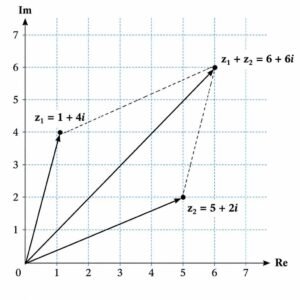
Fig. 1 Addition of complex numbers
To understand subtraction pictorially in the complex plane note that
$$z_1\mathbin{-}z_2=z_1+(\mathbin{-}z_2)$$
$\mathbin{-}z_2$ is $z_2$ reflected in the origin and we add this to $z_1$ via the parallelogram rule as shown in Fig. 2
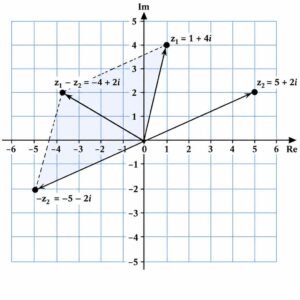
Fig. 2 Subtraction of complex numbers
To multiply use the distributive law
$$z_1z_2=(a+bi)(c+di)= ac+bdi^2+bci+adi =(ac\mathbin{-}bd)+i(bc+ad)$$
To divide write
$$\frac{z_1}{z_2}=\frac{a+bi}{c+di}$$
We can make the denominator real by multiplying by $c\mathbin{-}di$
$$\frac{z_1}{z_2}=\frac{a+bi}{c+di}\frac{c\mathbin{-}di}{c\mathbin{-}di}=\frac{ac\mathbin{-}bdi^2+bci-adi}{c^2\mathbin{-}d^2i^2\mathbin{-}cdi+dci}=\frac{(ac+bd)+i(bc-ad)}{c^2+d^2}=\frac{ac+bd}{c^2+d^2}+i\frac{bc\mathbin{-}ad}{c^2+d^2}$$
To add or subtract two complex numbers in exponential form we can convert them to rectangular form where we can easily carry out the addition or subtraction after which we convert the result back to exponential from. Alternatively we can use the following formulas which we ask the reader to show.
if
$$r_1e^{i\theta_1}\pm r_2e^{i\theta_2}=re^{i\theta}$$
then
$$r=\sqrt{r_1^2+r_2^2\pm2r_1r_2\cos(\theta_1\mathbin{-}\theta_2})$$
and
$$\theta=\arctan\frac{r_1\sin\theta_1\pm r_2\sin\theta_2}{r_1\cos\theta_1\pm r_2\cos\theta_2}$$
to make up for this complication, multiplication of complex numbers is especially simple in exponential form as shown here
$$r_1e^{i\theta_1}\times r_2e^{i\theta_2}=(r_1r_2)e^{i(\theta_1+\theta_2)}$$
which may alternatively be stated as
$$\mod(z_1z_2)=\mod(z_1)\mod(z_2)$$
$$\arg(z_1z_2)=\arg(z_1)+\arg(z_2)$$
Similarly division of complex numbers is straightforward in exponential form as shown here
$$\frac{r_1e^{i\theta_1}}{r_2e^{i\theta_2}}=\left(\frac{r_1}{r_2}\right)e^{i(\theta_1\mathbin{-}\theta_2)}$$
which is just the same as saying
$$\mod\left(\frac{z_1}{z_2}\right)=\frac{\mod(z_1)}{\mod(z_2)}$$
$$\arg\left(\frac{z_1}{z_2}\right)=\arg(z_1)\mathbin{-}\arg(z_2)$$
Having tackled the basic operations on complex numbers we now introduce a new concept – the complex conjugate. If
$$z=a+bi=(a, b)=(r, \theta)=r(\cos\theta+i\sin\theta)=re^{i\theta}$$
then the complex conjugate $\bar z$ of $z$ is defined to be
$$\bar z=a\mathbin{-}bi=(a, \mathbin{-}b)=(r, \mathbin{-}\theta)=r(\cos\theta\mathbin{-}i\sin\theta)=re^{\mathbin{-}i\theta}$$
The last two expressions for the complex conjugate are consistent because cosine is an even function and sine is an odd function. So
$$e^{i\theta}=\cos\theta+i\sin\theta$$
implies that
$$e^{\mathbin{-}i\theta}=\cos(\mathbin{-}\theta)+i\sin(\mathbin{-}\theta)=\cos\theta\mathbin{-}i\sin\theta$$
Note: In Quantum Mechanics a bar above a variable denotes the mean so the complex conjugate is denoted by an asterisk thus $z^*$.
If $z$ and $\bar z$ are plotted in the complex plane then it can be seen that they are mirror images of each other for reflections in the real $x$ axis as shown in Fig. 3. Incidentally Fig. 3 suggest that
$$\mod(\bar z)=\mod(z)$$
$$\arg(\bar z)=2\pi\mathbin{-}\arg(z)=\mathbin{-}\arg(z)$$
we ask the reader to show both of these by formal calculation.
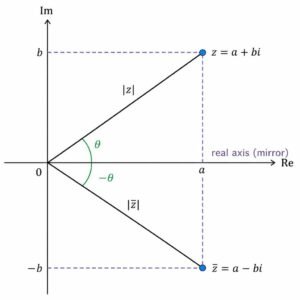
Fig. 3. A complex number and its complex conjugate
Given $z=a+bi$ we know that the conjugate of $z$ is $\bar z=a\mathbin{-}bi$. This means that the conjugate of the conjugate of $z$ is given by
$$\overline{\overline{z}}=\overline{a\mathbin{-}bi}=a+bi=z$$ Thus complex numbers come in pairs each of which is the conjugate of the other. Numbers on the real axis are their own conjugate that is they are self conjugate.
Once we accept the validity of complex numbers we can find complex solutions to algebraic equations with no real solutions. A good example is the quadratic equation $ax^2+bx+c=0$ whose solutions are given by
$$x=\frac{\mathbin{-}b\pm\sqrt{b^2\mathbin{-}4ac}}{2a}$$
The discriminant $d$ is the part under the square root sign i.e. $d=\sqrt{b^2\mathbin{-}4ac}$
If $d>0$ we have two distinct real roots given by
$$\frac{\mathbin{-}b\pm\sqrt{b^2\mathbin{-}4ac}}{2a}$$
If $d=0$ we have two repeated roots given by
$$\frac{\mathbin{-}b}{2a},\frac{\mathbin{-}b}{2a}$$
If $d<0$ we have two distinct complex roots that are conjugate to each other and given by
$$\frac{\mathbin{-}b}{2a}\pm i\frac{\sqrt{4ac\mathbin{-}b^2}}{2a}$$
We now derive an interesting relationship between a complex number, its conjugate and its modulus namely the relation
$$z\bar z=|z|^2$$
Proof using rectangular form
$$z\bar z=(a+bi)(a\mathbin{-}bi)=a^2\mathbin{-}abi+bai\mathbin{-}b^2i^2=a^2+b^2=r^2=|z|^2$$
Proof using exponential form
$$z\bar z=re^{i\theta}re^{\mathbin{-}i\theta}=r^2=|z|^2$$
An alternative proof
$$\mod(z\bar z)=\mod(z)\mod(\bar z)=r\times r=r^2=|z|^2$$
$$\arg(z\bar z)=\arg(z)+\arg(\bar z)=\theta\mathbin{-}\theta=0$$
Thus
$$z\bar z=|z|^2e^{i0}=|z|^2$$
In Quantum Mechanics the probability amplitude or wavefunction is a complex function $\psi(x, t)$ of space and time. The actual probability density at any point is space and time is given by the square of its modulus. Thus
$$P(x, t)=|\psi(x, t)|^2$$
Often $\psi(x, t)$ is very unweildy involving numbers, a few variables, square roots, $\pi$ and several instances of $i$. When this happens we usually cannot calculate $P(x, t) =|\psi(x, t)|^2$ by writing $\psi(x, t)$ in the form $a+bi$ and using $|\psi(x, t)|^2=a^2+b^2$. Instead we write the complex conjugate $\psi(x, t)^*$ by negating every instance of $i$ that is we replace every $i$ in $\psi(x, t)$ by $\mathbin{-}i$. Then we use $P(x, t)=|\psi(x, t)|^2=\psi(x, t)\psi^*(x, t)$. For practice try the following problem.
Calculate $P(x, t)$ given the wave function
$$\psi(x, t)=\frac{e^{\frac{\mathbin{-}x^2}{2a^2\left(1+\frac{i\hbar t}{ma^2}\right)}}}{\sqrt{\sqrt{\pi}\left(a+\frac{i\hbar t}{ma}\right)}}$$
Its now time for a little theorem.
Theorem B0201: If $z=\bar z$ then $z$ is real. Let us first try to see why intuitively why this must be true before a formal proof. If $z=\bar z$ then $z$ and $\bar z$ coincide in the complex plane. Now since each is the mirror image of the other this can only happen if they both lie on the mirror i.e. the real axis.
Proof:
We start with $z=a+bi$, then from the definition of complex conjugate $\bar z= a\mathbin{-}ib$. Now if $z=\bar z$ it follows that $a+bi=a\mathbin{-}bi$ or $bi+bi=a\mathbin{-}a$ which simplifies to $2bi=0$. Thus $b=0$ and we have $z=a+0i=a$. So it follows that $z$ is real. Q.E.D.
This theorem is vital to Quantum Mechanics and here’s why. Linear Algebra tells us that every matrix has a set of values $\lambda$ called eigenvalues (eigen means proper in German). Now there is a special type of matrix called a Hermitian matrix that is used in Quantum Mechanics to represent variables (or more accurately observables) like momentum and energy. When we measure the energy of quantum system in a lab the result we get must be one of the energy eigenvalues of the corresponding matrix which may contain complex entries. However these eigenvalues must always real since it does not make sense to measure energy and get a value like $5+3i$ joules. Elementary Quantum Mechanics textbooks thus prove (or ask the reader to prove) that the eigenvalues of a Hermitian Matrix are real. This is done by showing that they satisfy $\lambda=\lambda^*$ whence the result follows from our theorem.