
Calculusity
Elementary Theory of Space Flight
In this lesson we will calculate
(i) the velocity $v_\text{orbit}$ of a LEO satellite
(ii) the velocity $v_\text{launch}$ needed to launch a LEO satellite
(iii) the orbital period of satellites at various heights
(iv) the speed of escape $v_\text{escape}$ to escape from earth’s gravity and just reach infinity.
The results are quite general and easily extended to other heavenly bodies besides earth. Note we use $g$ to mean the gravitational field strength on the surface of the earth of radius $R$ and $g^{\prime}$ to mean the gravitational field strength at a point in space distant $r$ from earth’s center.
Part I: Velocity of a LEO satellite
The circular orbit of a satellite around earth is a combination of the following two motions
(i) the straight-line motion due to its inertia that tends to make it fly off along a tangent to the circular orbit
(ii) the acceleration towards the center of the earth that makes it falls inward.
When the velocity is just right for the distance these two motions balance perfectly and the satellite follows a circular path. If the satellite has a velocity $v$ we may think of it as moving along the tangent a distance $v\delta t$ in a short time interval $\delta t$ and then falling or accelerating a distance $\frac{1}{2}g^{\prime}\delta t^2$ towards the earth.
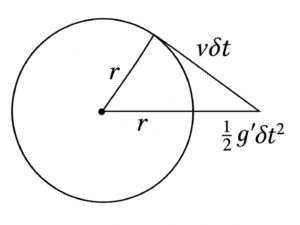
Fig. 1. Satellite Geometry. Earth is the dot at the center, the satellite flies off along the tangent for a distance $v\delta t$ and then falls back towards the earth the correct distance $\frac{1}{2}g^{\prime}\delta t^2$ to stay on the circular orbit.
Referring to Fig. 1. and using Pythagoras’ Theorem we get
$$r^2+v^2\delta t^2=(r+\frac{1}{2}g^{\prime}\delta t^2)^2=r^2+rg\delta t^2+\frac{1}{4}{g^{\prime}}^2\delta t^4$$
Since $\delta t$ is small we drop $\delta t^4$ as it would be extremely small. This gives
$$r^2+v^2\delta t^2=r^2+g^{\prime}r\delta t^2$$
or
$$v=\sqrt{g^{\prime}r}$$
This formula has a simple interpretation. If you are at a point in space $r$ distant from earth and you know the gravitational field strength $g^{\prime}$ there then use it to calculate $v$. If you then project a satellite with velocity $v$ at ninety degrees to the radius vector at your location the satellite falls into a circular orbit. For a satellite in LEO $g^{\prime}\approx g$ and $r\approx R$. Thus
$$v_\text{orbit}=\sqrt{gR}$$
Putting the numerical values of earth’s gravitational field strength and radius gives the following velocity for Low Earth Orbits
$$v_\text{orbit}=8.0\text{km/s}$$
Part II Velocity Needed to Launch a LEO Satellite
The centripetal force $\frac{mv^2}{r}$ that keeps a satellite in a circular orbit is provided by the gravitational attraction between it and the earth which is $\frac{GMm}{r^2}$. Equating the two gives
$$\frac{mv^2}{r}=\frac{GMm}{r^2}$$
or
$$mv^2=\frac{GMm}{r}$$
Since in the previous lesson we saw potential energy is $\mathbin{-}\frac{GMm}{r}$ it means the total energy (kinetic + potential) is
$$E=\frac{1}{2}mv^2+U=\frac{GMm}{2r}\mathbin{-}\frac{GMm}{r}=\mathbin{-}\frac{GMm}{2r}$$
Before the satellite is launched it is at rest on the earth’s surface with zero kinetic energy. Hence its total Energy is then all potential and given by
$$E^{\prime}=\mathbin{-}\frac{GMm}{R}$$
Hence to put the satellite in a circular orbit of radius $r$ it must be given energy boost of
$$E\mathbin{-}E^{\prime}=\mathbin{-}\frac{GMm}{2r}\mathbin{-}\mathbin{-}\frac{GMm}{R}=GMm\left(\frac{1}{R}\mathbin{-}\frac{1}{2r}\right)$$
For LEO satellites $r\approx R$ and
$$E\mathbin{-}E^{\prime}=\frac{GMm}{2R}$$
If all this energy is provided in the form of kinetic energy at lift-off with velocity $v_\text{launch}$ then
$$\frac{1}{2}m{v_\text{launch}}^2=\frac{GMm}{2R}$$
or
$$v_\text{launch}=\sqrt{\frac{GM}{R}}=\sqrt{\frac{GM}{R^2}R}=\sqrt{gR}$$
So we see that
$$v_\text{launch}=v_\text{orbit}$$
Thus the velocity needed to launch a LEO satellite is the same as the actual velocity of the satellite when it is in low earth orbit.
Part III The Orbital Period
As the distance from earth $r$ grows so does the circumference of the orbit. A satellite in a higher orbit has more distance to go around the earth but also moves faster (Kepler’s Law of Areal velocity). How do you think the orbital period will go with distance $r$? Let’s investigate
$$T=\frac{2\pi r}{v}=\frac{2\pi r}{\sqrt{g^{\prime}r}}=2\pi\sqrt{\frac{r}{g^{\prime}}}=2\pi\sqrt{\frac{r}{\frac{GM}{r^2}}}=2\pi\sqrt{\frac{r^3}{GM}}$$
Thus $T^2$ is proportional to $r^3$ or $T$ goes as $r^{1.5}$ This is Kepler’s Third Law of planetary motion (holds not only for planets but also for other orbiting bodies like moons and satellites). For a satellite close to the earth
$$T=2\pi\sqrt{\frac{r}{g^{\prime}}}=2\pi\sqrt{\frac{R}{g}}$$
this is the same as the period of a simple pendulum undergoing small oscillations with length equal to earth’s radius. The actual value can easily be calculated and shown to be around 83 minutes. LEO satellites can be observed from the ground after dusk. The sun has just dipped below your western horizon but the satellite is high enough for the sunlight to reach it still and make it shine, sometimes as brilliantly as Venus. Using the fact that the satellite takes 83 minutes to complete a full orbit of 360 degrees calculate how long it would take to cross the field of vision of a small telescope under x30 magnification. Using
$$T=2\pi\sqrt{\frac{r^3}{GM}}$$
we can show that at a height of 35,800km the period is 24 hours. These are geosynchronous satellites that orbit in step with the rotation of the earth. From the surface they appear stationary in the sky obviating the need to track them with ground antenna. At a height of 384,000km we reach the moon and the period is about 28 days which is the length of the lunar cycle.
Part IV The Speed of Escape
Using the formula $U=\mathbin{-}\frac{GMm}{r}$ we may calculate the potential per unit mass $m$ at earth’s surface, at the moon and at infinity. The results are shown in the following table.
\begin{array}{|c|c|c|}\hline\text{Location}&\text{Distance r in meters}&\text{Potential Energy per unit mass in J/kg}\\\hline\text{Earth’s Surface}&6,400,000&\mathbin{-}63,000,000\\\hline\text{Moon}&400,000,000&\mathbin{-}1,000,000\\\hline\text{Infinity}&\infty&0\\\hline\end{array}
So if our rocket must escape earth’s gravity and get from earth’s surface to infinity the change in potential energy per unit mass is found by subtracting $(0)\mathbin{-}(\mathbin{-}63,000,000)=63,000,000$J/kg
So the total change in potential energy if our rocket has mass $m$ is 63,000,000$m$ joules. Equating this to the initial kinetic energy $\frac{1}{2}mv_\text{escape}^2$ and solving for $v_\text{escape}$ give an escape velocity of $v_\text{escape}=11.0$ kilometers per second. We can derive a formula for the speed of escape easily. If our rocket is at a distance $r$ with speed $v$ then its total energy (kinetic plus potential) is
$$E=\frac{1}{2}mv^2\mathbin{-}\frac{GMm}{r}$$
If $v$ is less than the speed of escape the the rocket comes to a dead stop before reaching infinity and falls back towards the earth. If $v$ is just equal to the speed of escape then the rocket comes to a stop at infinity. Its final kinetic energy as well as potential energy are both zero. Hence by conservation of energy we have
$$\frac{1}{2}mv^2\mathbin{-}\frac{GMm}{r}=0$$
$$v=\sqrt{\frac{2GM}{r}}=\sqrt{\frac{2GM}{r^2}r}=\sqrt{2g^{\prime}r}$$
This formula give the speed of escape at any distance from the earth. If we restrict our attention to the speed of escape for a rocket launched from the surface of the earth then
$$v_\text{escape}=\sqrt{2gR}$$
Note the interesting relation
$$\frac{v_\text{escape}}{v_\text{orbit}}=\sqrt{2}$$
Substituting the values of earth’s radius and gravitational field strength on the surface into the penultimate formula gives a speed of escape of 11.0km/s as before. Thus the speed of escape is a bit more than the 8km/s needed to put a satellite in low earth orbit. As an exercise calculate the change in potential per unit mass when our rocket flies from earth to moon and use it find the necessary launch speed. Obviously the answer will be between 8km/s and 11km/s. Which one do you think it will be closer to?