
Calculusity
Gravitational and Electric Fields
The force $\mathbf{F}$ experienced by a particle is said to be central if it always acts along the line joining the particle to some fixed origin and if its magnitude $|\mathbf{F}|$ depends only on the radial distance $r$ of the particle from the origin and not on its angular position. Thus at every point on a sphere centered at the origin the force has the same magnitude. We say that the force is spherically symmetric. Of the three spherical coordinates variables $r$, $\theta$ and $\phi$ the magnitude of the force depends only on $r$. Mathematically one may write
$$\mathbf{F}=F(r)\hat{\mathbf{r}}$$
where $\hat{\mathbf{r}}$ represents the unit vector in the direction of the radius vector. Examples of central forces are the Newtonian gravitational attraction between two masses and the electrostatic Coulomb attraction between two opposite charges. For both of these forces the function $F(r)$ is inversely proportional to $r$ squared and thus obeys the inverse square law which is expressed symbolically as
$$F(r)\propto\frac{1}{r^2}$$
or
$$F(r)=\frac{a}{r^2}$$
In the case of Newtonian gravity $a=GMm$ where $M$ and $m$ are the masses of the gravitating particles. Typically one of the masses is much larger and we let $M$ be the much larger mass e.g. the earth and $m$ to be the smaller one e.g. a spacecraft. $G$ is Newton’s Universal Constant of gravitation which has the value $6.67\times10^{\mathbin{-}11}$Nm$^2$kg$^{\mathbin{-}2}$. In the case of the Coulomb force between two opposite charges $Q$ and $q$, $a$ depends on the system of units. In the Gaussian system used for advanced work $a=\mathbin{-}Qq$. If the charges are those present in a Hydrogen atom namely a proton and electron then $a=\mathbin{-}(+e)(\mathbin{-}e)=e^2$.
We briefly mention three differences between gravitational and electric forces
(i) There are two types of charges positive and negative but only one kind of mass
(ii) Electric Forces can be attractive or repulsive but gravitational force are always attractive
(iii) Electric forces are much stronger than gravitational forces
The vector form of the inverse square law is
$$\mathbf{F}=\mathbin{-}\frac{a}{r^2}\hat{\mathbf{r}}=\mathbin{-}\frac{a}{r^2}\frac{\mathbf{r}}{r}=\mathbin{-}a\frac{\mathbf{r}}{r^3}$$
The minus sign means that the force is directed opposite to the radius vector. In Lesson 1 of our Vector Analysis course we showed that $\nabla\frac{1}{r}=\mathbin{-}\frac{1}{r^2}\hat{\mathbf{r}}$. Using this relation we may write the force vector $\mathbf{F}$ as
$$\mathbf{F}=a\nabla\frac{1}{r}$$
However force is the negative gradient of the potential energy $U$ which we will follow common practice and refer to as just the potential.
$$\mathbf{F}=\mathbin{-}\nabla U$$
comparing the last two equations we see that the potential is given by
$$U=\mathbin{-}\frac{a}{r}$$
This result for the potential may be derived in a more direct way using basic field theory as shown below. If the secondary particle falls towards the central particle a tiny distance $dr$ then the force $F$ does a small bit of work given by
$$dW=Fdr=\frac{a}{r^2}dr$$
Notice there is no minus sign here because both the force vector and the displacement vector are in the same direction (pointing towards the central particle). Positive work is done by the force in pulling the particle deeper into the field. The potential at $r$ is the total work done falling in from infinity to $r$ and is found by integration to be
$$U=\int_\infty^r\frac{a}{r^2}dx=\left[\mathbin{-}\frac{a}{r}\right]_\infty^r=\mathbin{-}\frac{a}{r}$$
as before. At $r=\infty$ the potential is zero. As the particle falls into the field it speeds up gaining kinetic energy and losing potential energy. Thus the potential is negative for any finite value of $r$. This is characteristic of attractive fields. Fields giving rise to repulsive forces cause positive potentials. For gravity as we have seen $a=GMm$ thus gravitational potential is given by
$$U=\mathbin{-}\frac{GMm}{r}$$
We also saw that $a=e^2$ for the electrostatic attration between an electron and a proton thus the famous Coulomb potential is given by
$$U=\mathbin{-}\frac{e^2}{r}$$
The word specific is used in physics to show that a quantity is independent of mass. Heat capacity depends on mass. The heat capacity of a lake is millions of times greater that the heat capacity of a bucket of water. However if we divide the heat capacity of any object by its mass we get the specific heat capacity of the substance it is composed of which is independent of mass. The specific heat capacity of water is 4200J/kg/K whether we are dealing with one drop or an entire reservoir. Similarly we can divide the gravitational potential energy of a field by the mass or charge of a small test particle. This gives a property of the field at the location of the test particle. The property is independent of the mass or charge of the test particle and and is called the specific gravitational potential $\phi$.
The field strength $g$ at a point in a gravitational field is the gravitational force acting on unit mass placed there.
$$g=\frac{F}{m}=\frac{\frac{GMm}{r^2}}{m}=\frac{GM}{r^2}$$
If we insert the gravitational constant and mass and radius of earth in the last formula above we find that on the surface of the earth the gravitational field strength is $g=9.8$N/kg. We can also apply this formula to find $g$ due to earth’s gravitational field at some point in space simply by using the appropriate distance $r$ or to find the field strength on any planet, star or moon after looking up its mass and radius. Since earth is 81 times as massive as the moon which roughly one quarter the size of earth then the moon’s field strength compared to earth’s is
$$\frac{\frac{1}{81}}{(\frac{1}{4})^2}=\frac{16}{81}\approx\frac{16}{80}=\frac{1}{5}$$
This is only an approximate calculation and the true answer is around $\frac{1}{6}$ meaning the gravity on the moon’s surface is six times weaker than on earth’s surface. Now the fifth equation of motion $v^2=u^2+2as$ tells us the height to which we can jump is $\frac{u^2}{2g}$ so this means you can jump six times higher on the moon compared to on earth. Since the force $F$ is called the weight of the object concerned we see that $g=\frac{F}{m}$ implies $g=\frac{W}{m}$ which gives us the famous formula for weight $W=mg$. Because Newton’s second law of motion says $a=\frac{F}{m}$ this means that the acceleration of a falling mass is $g=9.8$m/$s^2$. Thus there are two ways of looking at $g$. If an object is at rest somewhere near earth’s surface then gravity pulls each kilogram of its mass with a force of 9.8N so the gravitational field strength is 9.8N/kg. However if the object is freely falling then it experiences the acceleration due to gravity of 9.8m/$s^2$. For electric fields. The electric field strength $E$ is the electric force $F$ per unit charge $q$ or
$$E=\frac{F}{q}=\frac{\frac{Qq}{r^2}}{q}=\frac{Q}{r^2}$$
$E$ is measured in newtons per coulomb N/C. The electric analogue of $W=mg$ is $F=qE$.
Any gravitational or electric field may be represented diagrammatically by means of field lines drawn to show the path along which a small mass or positive charge moves. For a point mass or negative point charge the field is spherically symmetrical with field lines directed radially inwards towards the source mass or charge. Over a very small region of space the field is roughly uniform and the field lines are parallel and uniformly spaced. This is true of the local field we experience at any point on the surface of the earth. Running perpendicular to the field lines are equipotentials of constant potential.
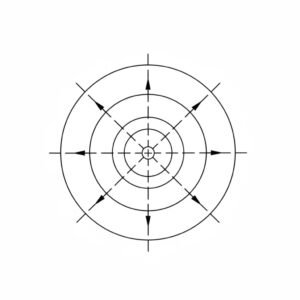
Fig. 1. Global picture of the electric field of a central positive charge. A small positive charge would be repelled away from the central charge along the radial field lines. The concentric circles are equipotentials of constant potentials. They are close together near the center where the field is strong and more spaced out farther away where the field is weak.
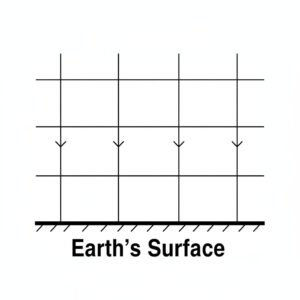
Fig. 2. Local Picture of Earth's Gravitational Field. If we take the global field of the earth and zoom in to a small region near the surface this is what we would "see". The vertical field lines are equally spaced to indicate the field is uniform. The arrows show the direction in which objects fall. The horizontal lines are equipotentials of constant potential.
We know that the term potential is just short for the potential energy at a specific point in a field. Unfortunately the term potential has another meaning which may cause some confusion. The potential $V$ is also the potential energy per unit mass (or charge) at some point of the field. For gravitational fields the potential is measured in J/kg and for electric fields potential is measured in J/C. One J/C is called one volt (1V). The potential difference $\Delta V$ between two points is the change in potential energy $\Delta U$ (or alternatively the work $W$ done) when unit mass or charge moves from point one point to the other. For gravitational fields we have
$$\Delta V=\frac{W}{m}=\frac{\Delta U}{m}=\frac{\mathbin{-}\frac{GMm}{r}}{m}=\mathbin{-}\frac{GM}{r}$$
Remember $W$ here is work done not weight. The corresponding formulas for electric fields are
$$\Delta V=\frac{W}{q}=\frac{U}{q}=\frac{\frac{Qq}{r}}{q}=\frac{Q}{r}$$
If an object of mass $m$ moves a distance $\Delta d$ in a gravitational field the change $\Delta U$ in potential energy equals the work done (force times distance). So we have
$$\Delta U=W=F\Delta d$$
$$\frac{\Delta U}{m}=\frac{F}{m}\Delta d$$
or
$$\Delta V=g\Delta d$$
so
$$g=\frac{\Delta V}{\Delta d}$$
If we divide both sides of $\mathbf{F}=\mathbin{-}\nabla U$ by $m$ we get the more precise vector form of this equation namely
$$\mathbf{g}=\mathbin{-}\nabla V$$
The potential is a scalar field and thus at every point there is a gradient vector showing the direction of most rapid increase. The gravitational field strength vector has the same magnitude as the gradient but points in the opposite direction. To illustrate the correctness of $g=\frac{\Delta V}{\Delta d}$ Consider a mass $m$ on earth’s surface. Its potential energy is zero. Now if we raise it to a height $h$ its potential energy becomes $mgh$. The difference in potential energy is
$$\Delta U=mgh$$
The difference in potential energy per unit mass is the potential difference given by
$$\Delta V=\frac{\Delta U}{m}=\frac{mgh}{m}=gh$$
Thus
$$\frac{\Delta V}{\Delta d}=\frac{gh}{h}=g$$
It is also clear the units work out as well since $V$ is measured in J/kg then $\frac{\Delta\text{V}}{\Delta\text{d}}$ is measured in $\frac{\text{J/kg}}{\text{m}}=\frac{\text{Nm/kg}}{\text{m}}=\text{N/kg}$ which is the unit of $g$. The electric analogue of $g=\frac{\Delta\text{V}}{\Delta\text{d}}$ is $E=\frac{\Delta V}{\Delta d}$ where $E$ is the electric field strength. Above we showed the $E$ has the unit N/C. Here we see $E$ is measured in V/m. Can you show that these units are equivalent?